The Role of References in Art
When an artist creates, they often rely on references or inspirations. A painter might draw from a sunset they once saw; a writer might borrow from their favorite book. So, if computers take references and create something new from them, does that disqualify their creations as art? After all, humans synthesize ideas from the world around them too.
Take Harold Cohen’s famous AARON program as an example. AARON is a computer program designed to create original drawings. The artwork it produces is undeniably unique and one-of-a-kind, but it only exists because Cohen programmed the computer with an understanding of what art is. AARON’s creations are extraordinary, yet they stem from pre-existing concepts encoded into its system.
~~~~~~
Originality and Creativity
This brings us to the crux of the issue: originality. For many, true art requires originality—creating something entirely new that has never existed before. Computers, by their nature, rely on algorithms and programming, which are based on human knowledge and pre-existing data. Even when a computer generates something seemingly unique, it’s the product of its programming and data inputs.
Does this mean computers are incapable of creativity? Not necessarily. A computer can combine elements in novel ways, creating works that might surprise and inspire us. However, its “creativity” is fundamentally different from human creativity because it lacks intent, emotion, and subjective experience.
~~~~~~
A Collaborative Future
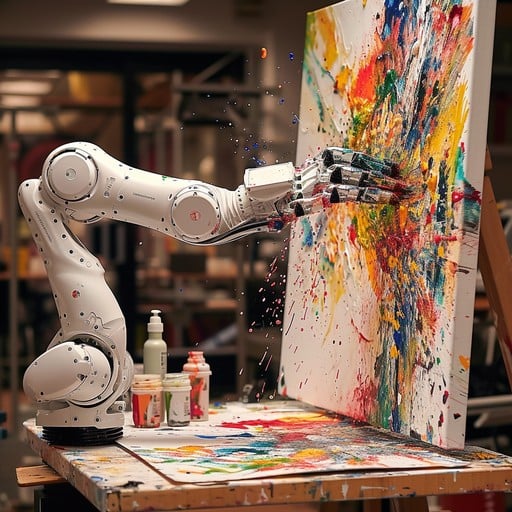
Perhaps the real question isn’t whether computers can make art, but how humans and computers can collaborate to push the boundaries of creativity. Programs like AARON show that when humans provide the framework, computers can generate astounding results. This partnership between human intent and computational power might redefine what we consider art in the digital age.
Computers might never replace human artists, but they can certainly expand the horizons of what’s possible in art. As technology evolves, so too will our understanding of creativity, originality, and the role machines play in the artistic process.
Art, whether made by human hands or computer algorithms, continues to inspire, provoke, and connect us. And maybe, just maybe, that’s what makes it art after all.

ChatGPT Prompt:
Create a blog post about arguing whether or not computers can make art using additional information and these few notes:
At first, I would’ve said no because the “art” produced is the product of the programming in the computer. After thinking a bit more, I came to this thought. Artists today use references and inspiration when creating their own art, so what difference does it make if a computer takes references and “creates” its own as well. Now what stopped me in my thinking path was originality. Is a computer able to create something completely original if it was programmed based on pre-existing concepts? I believe this is where computers lack the ability to create art. A computer can create something unique and one of a kind, but due to the programming needed for a computer to accomplish these things, I believe it will always need “references”
Harold Cohen’s AARON is an example of this. While the computer was able to make completely original and unique drawings, it required programming in order to accomplish them. Sure the robot can create hundreds of thousands of completely original images, but it took creating a program based on “understanding what art is” in order to create them.
and follow this format for the blog writing: (inserted binary blog post)